Saturday, July 31, 2010

Girl on Book Action: 'Salem's Lot by Stephen King

‘Salem’s Lot by Stephen King
ISBN: 0-451-16808-9

Blurb:


The town knew darkness...and the awful, heavy silence of terrifying images grotesquely dancing in and out of the shadows...and stark white faces, huge empty eyes and long gnarled hands that reached out with lustful insistence...and the paralyzing fear of a diabolical corruption and a hideous peril more dreadful than death.

But no one living in ‘Salem’s Lot dared talk about the high, sweet, evil laughter of a child...and the terrible sucking sounds...

***


Aside:
It's about that time again, when Wren and I pick a book / movie combo to review. This month (we seem to have fallen into a monthly habit) we give you our opinions on this "classic" vampire tale. So sit back and enjoy.


My Thoughts:


Guess what? ‘Salem’s Lot is the first Stephen King novel I’ve ever read. I bet you’re all gasping in surprise right now at how I could have avoided reading King until my mid-20s, but there you have it. I guess it goes hand-in-hand with not having read Interview with the Vampire until a couple of months ago.

Onwards, then, to an actual review, which is what you’re here for, right?

Part of the reason for reading this book, aside from filling in some of my fiction blind spots, is the vampire thing, which you all know by now is part of my studies. I have to tell you – there are no vampires in this novel until something like 150 pages in (your number may vary depending on edition). Up until that point, there are many descriptions of the people that live in this town – ‘Salem’s Lot – and some vague hints at a possible ghost story. If I hadn’t known going in that it was a vampire novel, I probably would not have picked up on that for a good long while. Reading about all of these different townspeople wasn’t necessarily my cup of tea. To be honest, until people started getting killed I was pretty bored and wishing that the story would get on with it. There was a lot of pontificating on the evils of society and the slow crumble of the moral fibre of the younger generation. Boring. The only upside to this long introduction is that when people die, and they die, believe me, their deaths have more impact on the reader.

The vampires were appropriately scary and not at all romantic or sexy, which was nice, but expected from everything I had previously read about them in my research. Barlow (the main vampire guy) didn’t scare me too much, but the child vampires are terrifying (all child vampires are, trust me). Nothing creepier than a little kid ready to rip your throat out. Little monsters. It was refreshing to read what I would consider to be proper vampires that don't sparkle and make it their life-mission, umm death-mission?, to make humans suffer. Barlow was not a nice guy, even if he didn't scare the pants off me as I had secretly hoped he would.

And now I’m going to be a bit of a hypocrite, so please excuse me. I really didn’t like how much the main character, Ben Mears, made me think of King – tall, dark-haired writer guy. It was one of the things that really bothered me about the novel. Why does this make me a hypocrite? Well, because I read plenty of novels where writers write about pretty much themselves and I enjoy them (The Bell Jar, The Red Tree, etc.) but I didn’t like it here. I suspect my dislike stems from Ben Mears becoming a hero, which seems too much like self-satisfying fantasy. You’re supposed to more or less like Mears, whereas I don’t think you can truly like Esther Greenwood or Sarah Crowe; they are not heroic in the least. Mears needed flaws to make him a likeable and believable character, and aside from having gotten into a motorcycle accident he just wasn't measuring up in the flawed human being department. I much prefer self-centered navel-gazing to self-centered hero-creation I guess.

Something I did like is that King isn’t squeamish about building up characters and then killing them off. I mean, it’s pretty obvious from the prologue that not a whole lot of people survive Barlow’s move into ‘Salem’s Lot, but knowing that and seeing it unfold are two different things. Which isn’t to say that I necessarily had a strong emotional attachment to any of the characters. Still, a couple of deaths were surprising to me (regardless of the prologue) just because they felt counter to what you’re used to reading these days in vampire books. Interestingly enough, the characters who survive are the ones I cared the least about – go figure, right.

Overall though, I have to say that ‘Salem’s Lot is worth reading if you’re interested in the vampire genre and if you want to read something that doesn’t romanticize the bloodsucking undead. While the book did feel like it was dragging with all of the different glimpses into the lives of the townspeople in the end there was quite a bit of action and vampire-hunting that mostly made up for the earlier slowness. If you can get through the first 200 pages without putting it down you get a pay-off at the end.

Tuesday, July 27, 2010

Weeks Too Late: Careful

Careful. Directed by Guy Maddin & written by George Toles & Guy Maddin.

Preconceptions: As promised (well probably threatened would be more accurate), this week I'm going to have a look at the strange comedic drama that is Careful. I had heard from a few third and fourth hand sources that Careful was a pretty funny satirization of old, German, black and white Bergfilm movies. In order to properly educate myself (a dangerous notion) I watched one of the source movies. If you didn't read last week's review: shame on you. While I ended up enjoying that a lot more than I expected, I thought of Careful as the pay off for doing my movie homework. I was prepared to enjoy a movie that poked fun at the neat and artful but kind of overblown Bergfilm.

General Review: Since this is another flick that you might not have seen (what with it being an off the beaten path, weird Canadian movie) it's the story of a number of the inhabitants of Tolzbad, a town high in the Alps. Its location in an avalanche riddled area (the classier Tornado Alley of Europe) means that the townsfolk have to be quiet and careful (hey, just like the title!). This leads to an atmosphere of repression and we all know where that leads: wanting to have sex with your mom or dad. And may I say, I haven't been so beat about the head and neck with Oedipal scenes since Mel Gibson's Hamlet (except this was doing it on purpose).

While there was certainly a sense of ridiculousness to Careful I don't think I'd go so far as to call it a comedy. I'm well aware that the back of the box didn't promise comedy, but there were a number of jokey scenes, including a scene of unbuttoning coats during a duel that could have been lifted from an Airplane! style flick. There were also a number of tightly constructed jokes that were cleverly put together that left me thinking: "huh, that was skillful" but not laughing. But hey, even if I'm not rolling in the aisles (the aisles of my...living room, I guess?) I can appreciate a bit of intellectual comedy. It was pretty clear that even if it wasn't exactly meant to be a comedy, it was meant to have a comedic angle. And the juxtaposition between the dreary, joyless setting with the absurd seems like good ground for laughs to me. Unfortunately, those laughs rarely surfaced. Just putting something strange and wacky on screen, pointing at it and exclaiming: "this is a strange and wacky thing!" isn't always enough to make it funny.

It was a very neat looking movie. While the Holy Mountain wasn't the murkfest I was anticipating, most of the old black and white films I've seen have a certain grainy quality that Maddin was able to reproduce admirably. More specifically, the day dream and nightmare sequences were very like the Bergfilm ones I had seen without looking like they had been ripped off. He also captured the overall ambiance. As far as making a movie that was like a Bergfilm Maddin succeeded.

Careful was an interesting watch. Maddin certainly recreated the dire, oppressive feeling of the old German movies he was emulating, but I don't know that I would recommend it. It's well put together, there are some funny bits and it is unusual. As an experiment in film making, it was successful but it wasn't exactly entertaining. This might be because I've already been through my David Lynch phase of enjoying weirdness for its own sake. Weirdness can still hook me, but once I'm on the line I need more to metaphorically bash my head in to keep me from flipping back out into the water (and other fishing analogies). While Careful certainly caught my attention, it lacked in the head bludgeoning department (the above Oedipal comment aside).

I'm also left uncertain as to whether someone who hasn't recently seen a couple of old German movies would even enjoy this as much as I did (which is only mildly). Without the context I think it would be less interesting. And while I like that it didn't talk down to me, I'm not sure assuming that your watchers have taken a 1920's German film class is a good move.

Aside: As a (sort of) Canadian, it's always funny to see what the government gives grants to in a desperate attempt to create Canadian culture. Well, at least this one was interesting and not about the Prairie life, for once.

Next week I'll be back to something more mainstream and not foreign, promise (but I do have a queue full of strange stuff, so for how long?)

Saturday, July 24, 2010

Girl on Book Action: The Magic Engineer by L.E. Modesitt, Jr.

The Magic Engineer by L.E. Modesitt, Jr.
ISBN: 0-812-53405-0

Blurb:


"Now in The Magic Engineer, we return to the magical island of Recluce, where Dorrin, a young scion of the Order magicians, is interested in forbidden knowledge, in the workings of machines. Promising, intelligent, but determined to follow his passion for scientific knowledge, Dorrin can invent machines. He is the Leonardo da Vinci of his age, but his insights violate the rules of the Order magic of Recluce. Now he must go into exile in the lands of Chaos to pursue his dangerous inventions.

"Yet he remains loyal to the idea of Order, and is tortured by the knowledge that to preserve it he must constantly create new devices for war. For the forces of the Chaos wizards are moving across the land, devouring whole countries and creating an empire -- whose ultimate goal is the destruction of Recluce."

***

Aside
: The blurb is once more from the official fan site since these books don’t seem to have back-cover blurbs on them. This site is also very useful if you need to figure out in what order to read the books, so you should definitely have a look at it.

My Thoughts:


The Magic Engineer
is the third book in the Recluce series and if you remember I reviewed the first and the second already. When reviewing the second I said that I was hoping that this next one would not also be another coming-of-age of a hero story and I was, of course, disappointed. The first section, in particular, felt as if I was just reading The Magic of Recluce and The Towers of the Sunset again, but the later parts of the book turned out to be entertaining in their own way. Still, I have a feeling I’m mostly going to gripe about the things I didn’t like, rather than tell you it’s a great book. Despite all of that, I do feel it was worth reading, because it added depth to my understanding of the magic system of this world and I enjoyed some of the characters quite a bit.

So, let me gripe.

Aside from the already-mentioned repetitiveness, I have my usual nit-picky complaints about bad editing. Once again, there were enough small errors (repetition of words, extra words like “the” or “is”) and misspellings that I started to really notice them. I can only tolerate so many mistakes before it starts to bother me and this book had enough that it was annoying.

Some of the very detailed descriptions of the smithing process got to be tedious and I’d skip over entire paragraphs that pretty much just told me how something was made with a bunch of jargon I didn’t understand. It’s great that Modesitt seems to have done a bunch of research to know about blacksmithing, but that doesn’t mean he has to describe every minute detail, or if he wants to show off his knowledge he can do it once or twice. There were too many “Dorrin hits hot metal with his hammer, turns metal, hits metal again, makes metal hotter” scenes. Nevermind that I don’t know what it means when something is being “fullered,” which came up quite frequently.

I’m starting to really dislike the relationships in these books and I guess the portrayal of some of the women, or at least, the women that the main characters end up with. Creslin and Megeara were a painful couple to read about since she didn’t really get a choice, and Dorrin’s love for Kadara seemed like it was a set-up for a similar relationship. I was pleased when that didn’t develop (oops, was that a spoiler?), but the relationship he has with Liedral didn’t really do anything for me. I actually think a novel about Kadara might have been more interesting since she is a dual-wielding warrior, rather than a smith who gets headaches when he so much as lies because it’s not order-based. I suppose some of this might go back to my preference for female protagonists.

Hmm, I think that’s all of my major complaints. I have to say again, that I hope the next book is not more of the same. I don’t think I have book four on hand so it may be a while before I get around to reading it, so at least if it is more of the same the first three will have faded in my memory a little.

Now that all of the griping is out of the way, let me leave you with some positive thoughts. I really enjoyed reading about the Chaos wizards and all of their scheming and intriguing. Now, a book about the Chaos side would be really interesting. The fact that if you use too much magic the other side gets stronger was also a good aspect of the world-building. The idea of a balance between white and black / chaos and order worked really well in the story and made it so neither side could just overpower the other. The last item I liked was that using magic for Dorrin and other order-based wizards in order to destroy or kill doesn't just give them moral anguish, but causes actual physical pain and blindness. So when characters regret their actions with regard to destruction (on the Order side of things) they don't just do it out of some navel-gazing sense of morality, but because it physically hurts them.

So, there were some good aspects to the novel. While the world building and magic system in these books will likely keep me coming back to read more, it would be more interesting if the characters were more varied and the story lines unique.

Tuesday, July 20, 2010

(Nearly) A Century Too Late: The Holy Mountain

The Holy Mountain. Written & Directed by Arnold Fanck.

Preconceptions: Awww, a movie from the 1920's? I don't wanna! It's going to be murky and boring and paced so slowly that I'll be able to wander out of the room, come back and nothing will have happened. Why am I putting myself through this trial? Well, I want to watch Careful for next week, which is supposed to be a pretty funny satirization of the whole Bergfilm genre (though I'm not so sure about a comedy that makes you do homework). But, considering I didn't know what a Bergfilm was, I figured I should watch one. As it turns out it's a movie about man vs nature, where a guy and his buddy gain some enlightenment up in the mountains. There is usually a love triangle thrown in as well (makes me wonder if Brokeback Mountain is one of these). I picked the Holy Mountain on Doomwench's suggestion and because it's reckoned to be one of the best and most iconic examples of what a Bergfilm is. Before you ask, yes, it's that Leni Riefenstahl starring in this (she went on to direct Triumph of the Will), but I can think of few things more dull than listening to me (a fairly ignorant secretary and criminology student) talk about about that particular kettle of fish-so I won't.

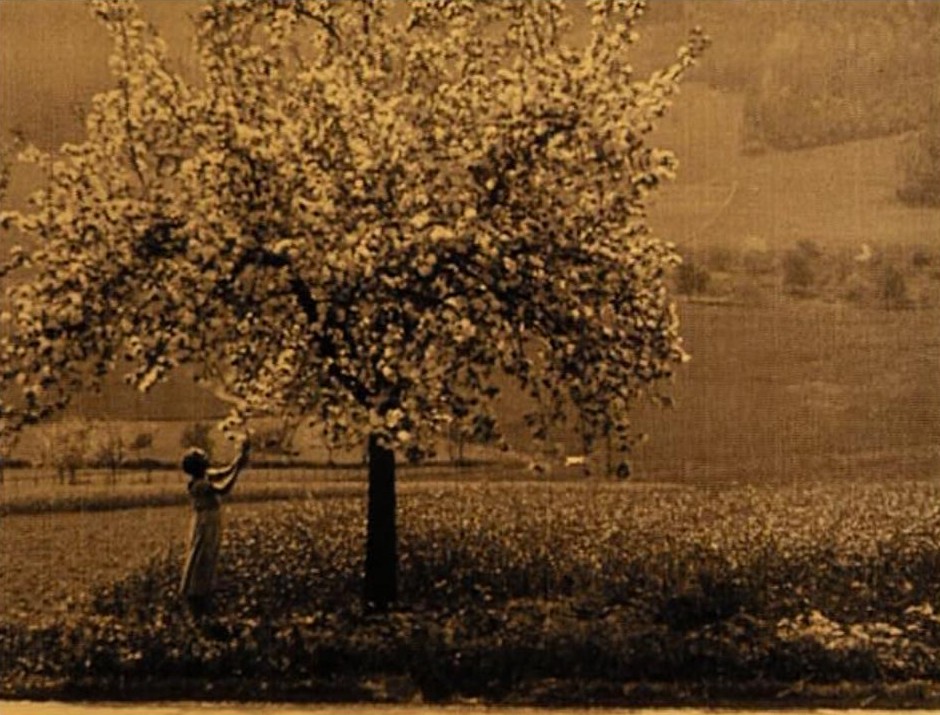
General Review: What surprised me most about The Holy Mountain was the lack of murk for a movie shot some 20 odd years after the invention of the first motion picture camera. It was beautiful and clear. Fanck gave a real sense of the scope of the Alps, scope was something else I wasn't expecting from a movie nearly 100 years old. Most of the silent films I've seen from this era are either shot in tiny sets or have so much distortion and gray around the edges that it's anyone's guess where the actors are supposed to be (some sort of parallel dimension, no doubt). There were also a surprising number of special effects, including a fairly believable mountain blowing up, artistic fade ins and avalanches.

I'll pause here briefly to give you a quick plot run down (because, shockingly, I don't think many other people have seen this old German movie). Riefenstahl plays Diotima, a dancer, who loves an unnamed mountaineer (Trenker). Trenker's young friend, Vigo, figures he's also in love with Diotima. Diotima is unaware of this and plans to marry Trenker. She treats Vigo like a child and when he wins a ski race and asks her for a hug, she agrees. Trenker sees this and in a jealous rage tricks Vigo into climbing a dangerous mountain. When neither shows up for her dance recital, Diotima discovers where they've gone and asks if any of the men in the audience will ski up to the mountaineer's lodge to send out a search party. The men in the audience turn out to be wusses, so she goes herself.

Unfortunately, while the setting is lush and textured (there I go, selling you guys a dessert again), the acting is not. With the notable exception of Luis Trenker (playing the unnamed friend), there was less acting than there was staring at the camera with blank looks on their faces. I know it must be difficult to emote properly without being able to use your voice, but very little attempt was made to do so. Riefenstahl's frolicking in the meadows, while pretty, was wooden and so was her sadness at discovering her fiance and friend were missing. Throwing your arms up in the air and clutching the walls doesn't mean you're sad and jumping up and down and flailing doesn't mean you're happy. I've been told that this is a particular failing of Fanck because the cast did a fine job when working under other directors.

Despite the overall unimpressive acting, there are a few shining moments. When Diotima asks Vigo what his favourite part of the dance was, he acts it out with her scarf in a surprisingly funny gesture. Riefenstahl's climb through the blizzard to the mountaineer's lodge is genuinely frightening and claustrophobic.
In fact, overall the physical acting was impressive, everyone did their own stunts and some of the shots of the mountaineering were breathtaking and occasionally symbolic. And, of course, I can't say enough nice things about Trenker, who seemed like the only actual actor in the bunch. Now there is a man who can emote silently (I think I may have developed a long dead crush).

Let's address my other major fear going into this: the pacing. I was even more frightened when I saw The Holy Mountain was nearly two hours long. It takes a particularly well paced modern movie to make me think it's worth passing the hour and a half mark. Surprisingly, for the most part, the movie didn't drag. Be forewarned, there is a ski race that is probably coming to a finish now, in 2010, and it took all my integrity not to fast forward through it. Putting the interminable race aside (with regret), The Holy Mountain actually moved along at a pretty good clip.There were some dance sequences (and I wondered if those were at least partially to show off Riefenstahl in a tiny outfit), which I figured would drag on endlessly (look! We have a professional dancer! Look!), but they were brief and often had other relevant scenes cut into them. In fact, the opening sequence, a dance with a poem cut into it, felt like a good short art film (and one that didn't copy, ahem I mean pay homage to, a ton of other movies). The plot itself was actually full of surprises, I'm so accustomed to modern cliches that I expected this movie to fall right in line, it didn't.

I assumed The Holy Mountain to be a movie I had to endure to better understand a certain type of movie and generally improve my knowledge of films. This simply wasn't the case. It stood as a pretty good flick on its own and something worth giving a look.

Saturday, July 17, 2010

Girl on Book Action: Fathom by Cherie Priest

Fathom by Cherie Priest
ISBN: 978-0-7653-2122-0

Blurb:


The ageless water witch Arahab has been scheming for aeons, gathering the means to awaken the great Leviathan. She aims to bring him and the old gods back to their former glory, caring little that their ascendance will also mean an end to the human race. However, awakening the Leviathan is no small feat. In fact, Arahab can’t complete the ritual without human aid.

Arahab’s first choice is Jose Gaspar, a notorious pirate from eighteenth-century Spain. But when the tasks proves too difficult for Gaspar, she must look elsewhere, biding her time until the 1930s, when the ideal candidate shows up: a slightly derranged teenager named Bernice.

Bernice is sophisticated, torn from New York and forced to spend a miserable summer on Anna Maria Island, a tiny rock off the coast of Florida. She’s also been saddled with the companionship of her farm-raised cousin, Nia. Eventually Bernice’s disenchantment gives way to rage, which leads to a deadly crime. When Nia won’t cover for Bernice’s actions, she turns on Nia, chasing her into the deadly coastal waves.

But the timing is right and the elementals have better ideas: the moment the girls go under, Bernice is commandeered for Arahab’s task force and Nia is turned into a strange and powerful new creature by a servant of the earth who doesn’t want to surrender its green fields and muddy plains – not yet, at least. Add in a hapless fire inspector who’s just trying to get his paperwork in order, a fire god whose neutrality has been called into question, and a bizarre religious cult, and rural Florida doesn’t seem quite so sleepy anymore.

***

My Thoughts:

I really wanted to like this book and I really tried – and I did enjoy reading it, but ultimately I feel disappointed. The idea is so good, but the execution left me wanting more. I think if it was twice as long, maybe it would have felt more complete, more satisfying. I actually feel a little bad about not liking this book as much as I wanted to, because the effort was solid, it just didn’t quite work for me. Just so you know, this review is likely to be peppered with minor spoilers.

Let me start with discussing the characters. The two cousins felt underdeveloped and their “miserable summer” together is actually only a day and then Bernice commits her crime and Nia flees from her into the ocean. Both of them are barely established as characters before they disappear for a while during their transformations. Then suddenly we’re introduced to Gaspar and I think he could have used some more detail, as well, especially his first attempt to awaken Leviathan, which is mentioned but only in passing. Arahab is meant to be evil and malicious, but I never felt that she was as threatening as she should or could have been. She mostly comes across as petulant, or even incompetent.

The pacing was too fast I think. In Boneshaker the pace was quick and that suited the narrative, what with being chased around the city by zombies, etc, but for this book it just made it feel rushed. Fantasy needs to be epic, especially when you’re dealing with old gods and bringing about the apocalypse. The world and myth wasn’t clearly established and involved a lot of guess-work and assumption for me as a reader. Very little about the creatures was ever fully explained. It just wasn’t very transparent.

And somehow I forgot for a good half of the book that the story was set in the 1930s, which I think is problematic. I should not be able to forget what time period we’re in. I think it points to not being fully immersed in the setting and not being shown enough of the world and the people in it.

One last gripe and then I’ll say some good things about this novel, really, I will, because it certainly wasn’t all bad, just disappointing. My last gripe has to do with the cult that the blurb mentions. And you might be able to guess what I’m about to say – the cult did not get enough page-time to be effective. It almost felt like it was thrown into the mix to make it more interesting, and wasn’t really explored and utilized to add depth to the story.

Okay, now for some positive thoughts.

Talk about imagination! I really think that the framework of the story that is here is wonderfully, powerfully imaginative. The ideas behind the novel are just great and are the reason that I really wanted to be able to gush about this book. It’s actually been difficult for me to write this review, because I respect the creativity that is apparent throughout the narrative and I want to be able to say only good things about it.

Let me conclude, before I start to repeat myself.

Despite the fact that I felt unsatisfied at the end, I would still recommend this book as long as you don’t have hugely high expectations of reading an epic dark fantasy. If you liked the fast pace of Boneshaker, you might also enjoy it in this novel. And if you just want to read something quick and imaginative you may also like it. Now, go read, minions.

Tuesday, July 13, 2010

Weeks Too Late: Sita Sings The Blues

Sita Sings The Blues. Written & Directed by Nina Paley.


Preconceptions: Recently, I moved out of the untamed wilds of Canada and while the adjustment has been difficult (not stalking small woodland animals and then devouring them still bloody and twitching, not praising the gods for rain) one of the greatest benefits of moving into civilization is Netflix. Oh I'm sure there are a thousand political reasons not to like them, but as a simple minded Canadian I wouldn't understand them anyways. While cackling with glee and filling the queue with vampire movies and all kinds of artsy foreign nonsense (something to look forward to in the upcoming weeks), I came across Sita Sings the Blues. The description went a little something like this (boring bits excised): "India's ancient epic Ramayana gets a fresh, funny makeover ...With song and humor, director Nina Paley juxtaposes the split between Rama and Sita with her own divorce to tell "the greatest break-up story ever told." Pretty neat, huh?


General Review: It's been so damned long since I watched anything I liked I was beginning to wonder if I'd become some sort of cynical husk unable to enjoy movies. As it turns out, there is at least a tiny bit of moisture in my husk. Sita Sings the Blues was funny, pretty and something I hadn't seen before. My gripes with it were minor and it was fun to watch. What's particularly neat about this movie is that you can watch or download it online here (http://www.sitasingstheblues.com). So I didn't actually need to leave my homeland to see it via Netflix, but give me a break, I couldn't possibly have heard about it in my hut.


Watchers beware, this is a musical (I love musicals, but I know there are people out there who inexplicably don't agree with me). There are regular breaks where Sita sings in the sexy jazz voice of Annette Hanshaw (y'know, the blues, like in the title). I dug that most of the musical numbers were done in this one voice and style, but it isn't the multi-genre, choral spectacular that is often in musicals (so some people might find the numbers get repetitive towards the end). For those of you who haven't taken leave of your senses and agree with me, you're in for a treat, the musical numbers are a visual and auditory treat.


As you may have noticed, this is a fairly picture heavy review. The reason (besides me not being willing to give up the weak gag cover bit)? The interesting and varied animation and look of the flick. So lets talk about the animation, Sita Sings the Blues was done in a number of styles that integrated into the story well (so many styles, in fact, that I don't have room for examples of them all) . In fact, they kept the switch between the narrators, musical numbers, main story and frame story from being confusing. The numerous layers of story could easily have been muddled but between good writing and animation choices, they weren't. The changing styles and cool design elements kept the simplicity of the actual animation from getting stale (nearly all of the animation was done by Paley). One of the few gripes I was talking about earlier does, unfortunately, come from some of the animation choices. Some of the scenes could have been tighter and cut shorter. When there was only orchestral accompaniment and little action taking place I sometimes wondered what I was supposed to be paying attention to.


The layer of the movie I enjoyed most was the three narrators who have an unscripted discussion about what they remember about the Ramayana story and their thoughts about it. This is where the movie is at its funniest both in animation and dialogue. One of my other few complaints about the movie is the story of the writer/director interspersed in the main action. I could see the relation to the main plot, but while the rest of the film felt natural and flowing (Girl on Book Action Incoherently Raves: "Sita Sings the Blues is like a river or a menstruation or something") these sections were jarring and unnecessary (the animation was still cool, though). I wouldn't mind seeing another movie about Nina Paley's life and break up, it wasn't that the story wasn't interesting on its own, it just didn't fit smoothly into the rest of the narrative.


Sita Sings the Blues is well worth checking out and it's a hell of a lot easier to do so, with it being online. I usually try not to be much of a shill (well not without being paid anyways) but this whole thing is fan funded, so if you dig it like I did, grab a t-shirt or throw a couple of bucks Nina Paley's way (end shill).